
Strengthening South-South Cooperation to Advance the Implementation of Global Climate Action
Held at the UNFCCC Pavilion in the Blue Zone at COP31
On the afternoon of 9 November, local time, the event themed “Strengthening South-South Cooperation to Advance the Implementation of Global Climate Action” was held at the UNFCCC Pavilion in the Blue Zone at COP31. The event was hosted by the International Green Development Coalition for the Belt and Road Regions (IGDC), supported by the Secretariat of the United Nations Framework Convention on Climate Change (UNFCCC), and attended by the United Nations Office for Project Services (UNOPS) and other organizations. For the first time, the event was held at the UN Climate Change Pavilion and livestreamed globally in its entirety. Representatives from government departments, UN agencies, financial institutions and the private sector. Participants exchanged views on how to translate climate commitments into practical actions that can be implemented, replicated and financed, bringing a strong sense of pragmatism from the Global South to this year’s climate conference, which places implementation at the heart of its agenda.
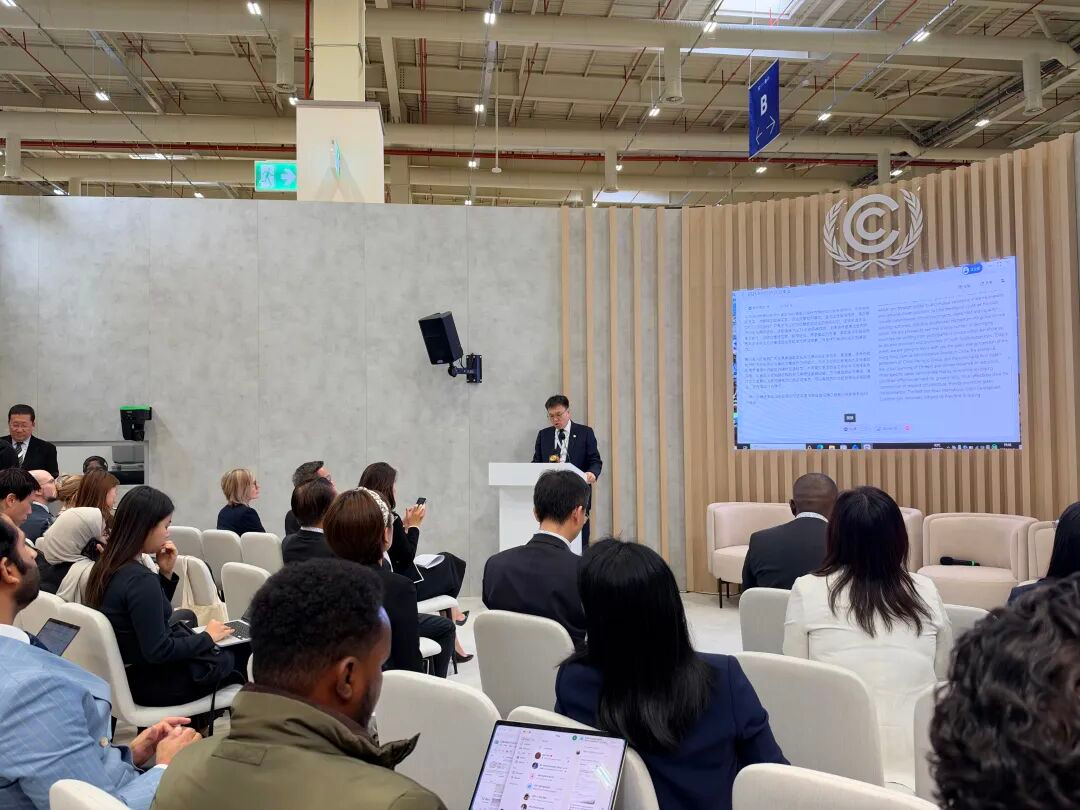
COP31 Focuses on Implementation, with South-South Cooperation Acting as a Catalyst
More than a decade after the adoption of the Paris Agreement, international climate governance is shifting from rule-setting to delivering results. As the opening year of a new decade, COP31 places implementation at the center of its agenda. At the opening ceremony of COP31, Simon Stiell, Executive Secretary of the UNFCCC, emphasized that COP31 must make every effort to turn solutions into action. In the past, climate conferences primarily served to send signals to national political systems and global markets by setting global targets and defining directions for action. Today, global climate governance has entered the implementation phase. COP31 must not only build on previous achievements, but also translate global targets and national climate plans into concrete steps and drive the implementation of practical solutions.
IGDC: Turning “Green Cases” into “Systemic Transformation”
Mr. Zhao Yingmin, President of the International Green Development Coalition for the Belt and Road Regions (IGDC), delivered opening remarks on behalf of the organizers. He noted that achieving the goals of the Paris Agreement depends not only on ambition and commitments, but also on concrete action and effective implementation. South-South cooperation serves as an important complement to North-South cooperation, helping developing countries translate their climate commitments into tangible outcomes in policymaking, projects, investment and capacity-building. He explained that IGDC was established on the initiative personally put forward by President Xi Jinping and has brought together more than 190 partners from 50 countries. During COP30 in Belém last year, IGDC and UNOPS jointly launched the Global Green Development Best Practices Call for Submissions and the Global Green Leaders Initiative. Looking ahead, IGDC is committed to advancing cooperation in three priority areas: building a platform for sharing best practices, facilitating green investment and financing partnerships, and strengthening capacity-building and knowledge-sharing. “The value of South-South cooperation lies in solidarity, and its vitality lies in action,” he said, calling on all parties to take Antalya as a new starting point and work together to connect the world and lead the way towards green development: “Connecting the World, Leading the Green Transition — Starting from Antalya.”
H.E. Selwin Charles Hart, Assistant Secretary-General and Special Adviser to the Secretary-General on Climate Action and Just Transition, United Nations, delivered remarks highlighting the importance of international cooperation. He noted that, thanks to China, renewable energy has become the cheapest, fastest and most secure source of electricity globally. Yet, in the more than ten years since the adoption of the Paris Agreement, only one dollar out of every five invested in clean energy worldwide has flowed to emerging and developing economies outside China, despite these countries being home to two-thirds of the world’s population. “Green innovation is changing what is possible, but international cooperation must change who benefits,” Hart emphasized. He highlighted the UN-led Global Grid Accelerator, which will initially provide support in regions including Africa and ASEAN, helping turn clean energy potential into reliable electricity. He called on all parties to make a concrete contribution, whether in the form of funding, technology or policy support.
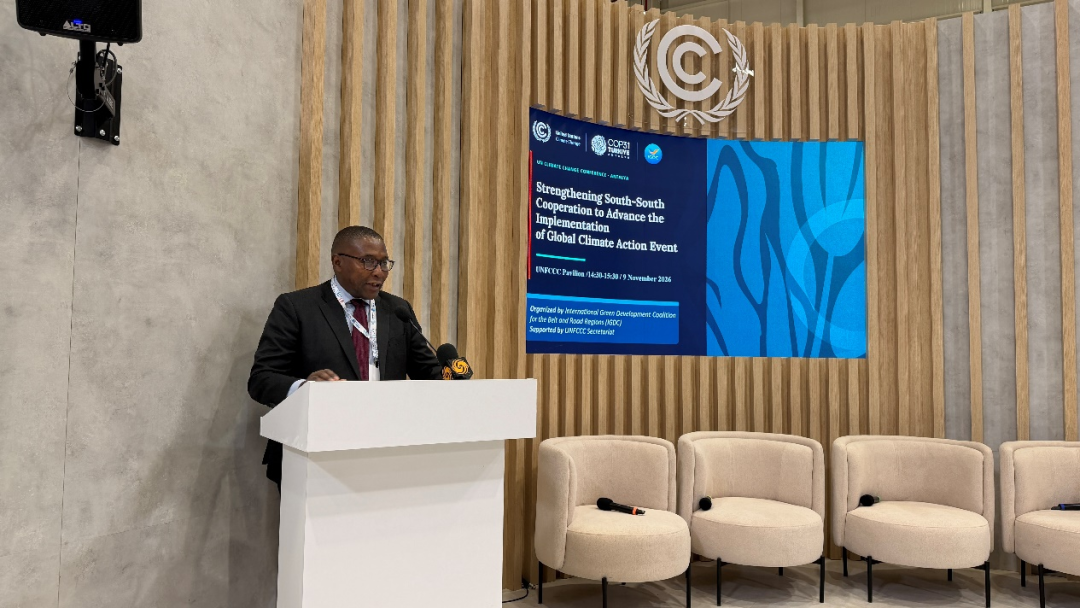
Three Cases: From Standards and Ecosystem Restoration to “Harmony Integration”
During the session on solutions for moving “from commitments to implementation”, three cases recommended by IGDC illustrated the diverse dimensions of South-South cooperation.
Green Hydrogen: Connecting Capital through Standards. P C Chan, Chief Executive Officer of the Hong Kong Quality Assurance Agency (HKQAA), introduced the green hydrogen certification scheme currently under development in Hong Kong. Drawing on Hong Kong’s more than 160 years of experience in the safe use of hydrogen-containing fuel gas, the scheme is expected to be launched in 2027. It aims to establish a credible, transparent and internationally aligned framework for assessing the greenhouse gas performance of green and low-carbon hydrogen. Through green development investment and financing partnerships, the scheme will help hydrogen projects in the Chinese mainland, Belt and Road partner countries and markets across the Global South access international capital and strengthen market confidence.
From Desert to Oasis: Embedding Ecological Restoration in the Value Chain. Ms. Gu Ruizhen, Vice President of Mengniu Group, shared the company’s experience in combating desertification in the Ulan Buh Desert.Originating in Inner Mongolia, the dairy company has, since 2009, developed an integrated industrial value chain linking desert restoration, grass cultivation, cattle farming, milk production and resource recycling. This circular model has transformed what was once described as a “sea of death”, an area receiving less than 70 millimeters of rainfall annually, into an oasis covering more than 220 square kilometers and the world's largest organic milk production base in a desert region. Through these efforts, soil organic matter content has increased from 0.09% to 2%, while soil pH has declined from 12 to 8.5. The initiative has helped 6,000 farming households achieve stable income growth. By the end of 2025, the project had achieved cumulative carbon sequestration of more than 1.38 million tonnes. This August, Mengniu and IGDC jointly launched the Global Green Leaders Alliance, translating China’s experience in reducing carbon emissions across the diary industry into replicable industrial solutions.
“Harmony Integration”: Tailoring Solutions to African Cities. Mr. Kaleb Menwyelet Munacha, the Founder and Chair of Windows of Green Africa presented the concept of “Harmony Integration”, which originated from Ethiopia’s experience in developing green infrastructure. The concept advocates viewing land, ecosystems, infrastructure, industries and trade as interconnected and interdependent components of an integrated system. Addis Ababa's Friendship Park provides a compelling example. An area once characterized by piles of waste and makeshift shelters made of plastic sheets has been transformed into one of the city’s most popular public spaces. Young people who were once regarded as part of the city’s “problems” have since been employed as horticultural workers and park stewards. “While transforming the land, we are also transforming people’s lives.” Rather than a fixed design, this approach is a methodology that can be adapted to different contexts. Through IGDC’s capacity-building and knowledge-sharing activities, it is now being adapted and replicated in African cities with different ecological and economic conditions. It also offers valuable experience that Ethiopia, the host of COP32, can share with other countries.
Shared Vision: Turning Projects on Paper into Tangible and Accessible Change
In her concluding remarks, Ms. Samantha Stratton-Short, Chief Climate Officer at the United Nations Office for Project Services (UNOPS), described UNOPS as a “partner in implementation” and emphasized that “implementation is at the heart of sustainable development”. UNOPS is working with IGDC on the Global Call for Green Development Case initiative to identify proven and replicable best practices. The formal call for submissions is scheduled to open in December this year and run through spring next year. Participants agreed that standards build confidence, power grids create connections, and ecological restoration strengthens resilience. When brought together, these elements can make climate action a shared engine for improving energy access, food security, public health and industrial development.
From a credible green hydrogen standard, to an oasis transformed from desert, and then to a framework of “Harmony Integration” tailored to African cities, this side event presented three compelling cases in response to the central question facing COP31: what does meaningful progress look like? Real progress does not lie in simply adding another well-intentioned exchange of ideas. It lies in accelerating the transformation of individual green success stories into replicable approaches, investment-ready project pipelines and portfolios of projects capable of reshaping entire regions.
Copyright © 2020 BRI International Green Development Coalition. All rights reserved.
Address: No.5 Houyingfang Hutong, Xicheng District, Beijing 100035, China
Postcode: 100035
Fax: (86)10-82200539
E-mail: secretariat@brigc.net


