
From November 17 to 19, the 33rd APEC Economic Leaders' Meeting and the 2026 APEC CEO Summit were held in Shenzhen. This marks the third time that China has hosted APEC. The Shenzhen Initiative of the 2026 APEC CEO Summit(hereinafter referred to as "the Initiative")was released, calling on all parties to join hands in building an open and inclusive, innovation-driven, interconnected and cooperative Asia-Pacific community of shared prosperity. On green development, the Initiative states: we call on APEC to promote energy transformation, take a coordinated approach to traditional energy, renewable energy and new energy, advance the development of marine energy infrastructure, and strengthen cooperation on early warning for energy security and on the exchange and sharing of information; we resolve to participate in the APEC Carbon Market Dialogue Forum, share the perspectives and best practices of the business community, advance carbon asset management practices, and maximize decarbonization outcomes while remaining consistent with each economy's commitments and multilateral commitments.
From APEC Beijing 2014 to APEC Shenzhen 2026, twelve years on, what China has brought to the Asia-Pacific is not merely a stretch of "APEC Blue," but a transformation logic that moves from "light green" toward "deep green."
China's Green Transformation Is Moving Overall from "Light Green" to "Deep Green": A Systemic Shift in the Development Paradigm
In 2014, "APEC Blue" embodied the public's simple aspiration for a better environment. Today, green has become a structural underpinning of China's development.
Since around 2014, China's economic growth has been "relatively decoupled" from the intensity of resource and energy consumption and from carbon emission intensity, and "absolutely decoupled" from the emissions of major pollutants and total water use — the economy has moved upward while emissions have moved downward, and environmental quality has undergone historic, transformative and holistic changes.
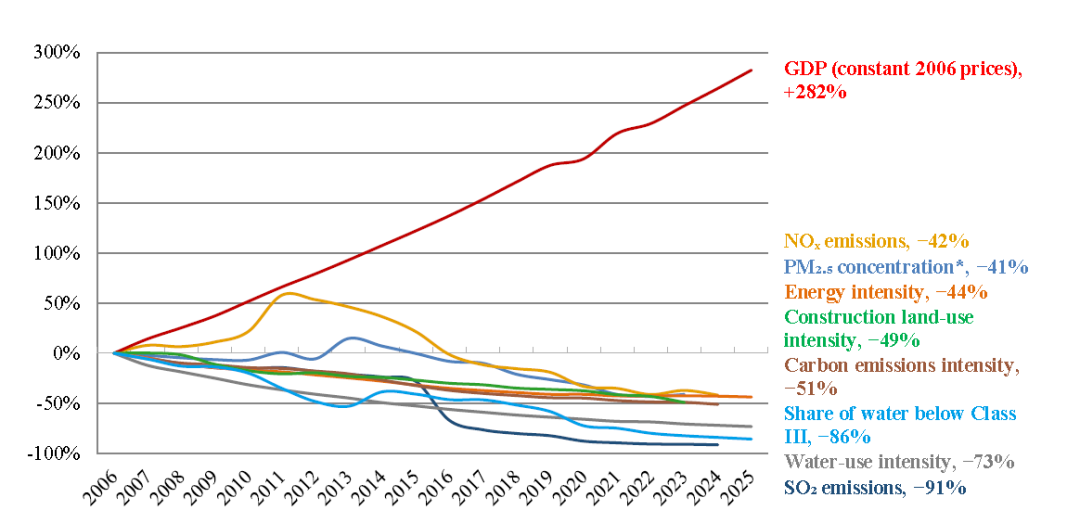
Changes in Major Socioeconomic and Ecological-Environmental Indicators,
2006–2025
(Source: CCICED High Level Task Force China’s Outlook on Environment and Development)
The deeper significance of this transformation lies in the restructuring of the development paradigm: from end-of-pipe treatment and piecemeal remediation to a comprehensive green and low-carbon transformation of production and lifestyles at the source; from single-dimensional ecological improvement to the mutually reinforcing and integrated progress of the ecological environment, the economy and people's well-being; and from the rollout of "light green" pilots to an irreversible leap to "deep green" — the energy mix has reached a turning point, industries continue to move toward new and green growth, and green benefits are tangible and real. Green is no longer a constraint on growth, but the underlying logic of new quality productive forces and high-quality prosperity.
China's Green Transformation Approach: A Complete System from Theory to Practice
This transformation is not accidental; it stems from a body of theoretical and institutional innovation that spans from ideas to practice. Guided by Xi Jinping Thought on Ecological Civilization, China has gradually built a complete system in which strategic positioning, medium- and long-term planning, action deployment, institutional safeguards, market drivers, technological support and capacity building work in concert. Five key pillars underpin this system:
Theoretical guidance—grounded in Xi Jinping Thought on Ecological Civilization and core concepts such as "lucid waters and lush mountains are invaluable assets" and "a sound ecological environment is the most inclusive form of public well-being";
Institutional strengths—ecological civilization has been written into the Constitution and codified in the Ecological and Environmental Code of the People's Republic of China, with phased environmental targets set through each five-year national plan;
Scientific and technological innovation—self-reliance in green and low-carbon technologies, moving clean technologies from "uneconomical" to "scaled deployment";
Two-wheel drive—the combination of an efficient market and a well-functioning government, with the national carbon market making emission reduction efficiency quantifiable and tradable;
Nationwide action—green production and green lifestyles reinforce each other, with consumer demand in turn reshaping supply.
This is more than a transformation pathway; it is an open, inclusive and replicable "Chinese approach."
IGDC's Role: Advancing the Green and Low-Carbon Transition of the Global South
The green transition is a shared agenda for the Asia-Pacific. APEC covers 21 member economies and 2.8 billion people and accounts for about 60 percent of global GDP; it is both a global growth engine and a region of concentrated energy consumption and carbon emissions. International organizations in the field of green development, such as the International Green Development Coalition for the Belt and Road Regions(IGDC), are becoming important platforms for advancing the global green transition. IGDC is committed to providing scalable green technology solutions, verifiable green finance instruments, shareable digital and intelligent empowerment platforms and replicable capacity-building models. Since its establishment, it has actively advanced the green and low-carbon transition of Global South countries and shared the green development stories of China and other Global South countries. Going forward, IGDC stands ready to cooperate with relevant institutions in APEC member economies to make green technologies more affordable, green rules more interoperable, and green transition capacity more universally shared.
Copyright © 2020 BRI International Green Development Coalition. All rights reserved.
Address: No.5 Houyingfang Hutong, Xicheng District, Beijing 100035, China
Postcode: 100035
Fax: (86)10-82200539
E-mail: secretariat@brigc.net


